
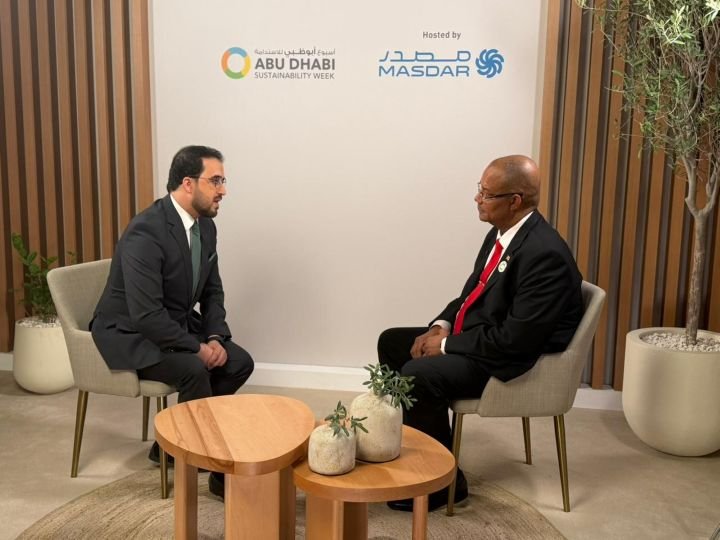
The President of the Republic, Dr. Patrick Herminie, spoke to Sky News Arabia about Seychelles’ active role in placing the nation at the centre of discussions during the Abu Dhabi Sustainability Week 2026. In this exclusive interview, the President shared insights on the country’s sustainable development priorities, climate action initiatives, and efforts to balance economic growth with environmental preservation. Here is an excerpt from his conversation with the Sky News Arabic journalist.
How important is sustainability for a country like Seychelles?
We have a unique biodiversity which we would like to preserve. At the same time, as a small island state, we must ensure greater prosperity for our people. There is a delicate balance between protecting our environment, including marine ecosystems, and promoting development.
Sustainability means pursuing development while preserving what we already have by ensuring that our people have a better livelihood. This is not always easy, as certain activities can sometimes negatively affect other areas. For example, the construction of a hotel will inevitably impact the surrounding ecosystem. This is why, in our country, we have very stringent rules governing development.
Nothing can proceed without an Environmental Impact Assessment (EIA). Any major project must receive approval from the relevant environmental authorities.
The real challenge for Small Island States is that they are on the frontline of climate change. In this context, what do you expect from major emitters, large economies, and global financial institutions?
We are also threatened by climate change in various ways, including rising sea levels and increasing temperatures. Mitigating these adverse effects is costly. While we are committed to being at the forefront of climate action, our financial resources are limited.
Most of the time, we are not the main contributors to greenhouse gas emissions, those are the larger countries. This is why we advocate for the Loss and Damage Fund, which would provide financial support to vulnerable countries from major emitters who recognize that we are suffering the consequences of their actions.
How significant is the risk that climate change poses to your country?
Climate change affects us in many ways and to varying degrees. Our low-lying islands are particularly vulnerable to sea-level rise, while we also face environmental and public health concerns, as changing temperatures may contribute to the emergence of new diseases. Our limited capacity to respond and adapt makes these risks even more serious. However, I do not believe our islands will be completely submerged, as Seychelles also has mountainous areas that offer a degree of resilience.
There are many challenges confronting us in the global economy and the wider geopolitical landscape. Are you concerned that, amid these pressures, climate action may be falling short and that Seychelles needs to accelerate its efforts?
We definitely need to accelerate our efforts. Rising sea temperatures, for instance, are already causing serious challenges, including the migration of fish stocks on which we depend for food security and livelihoods.
Unfortunately, much of the world’s attention is currently diverted towards immediate geopolitical concerns, such as conflicts, rather than long-term environmental threats. As human beings, we often struggle to appreciate the long-term benefits of acting decisively in the present. We are deeply concerned, and we call on the community to come to its senses and make the necessary investments so that, together, we can safeguard our planet as one human race.
Tourism is one of the most important sectors in Seychelles. How do you strike a balance between maintaining Seychelles’ competitiveness in the global tourism market while addressing the growing challenges posed by climate change?
This is a very delicate balance. While tourism is our primary source of income and the development of new hotels remains important, we fully recognise that one of Seychelles’ main tourism attractions is its pristine natural environment—hence the necessity for rigorous Environmental Impact Assessments. Tourism development and environmental preservation must therefore go hand in hand. By protecting our environment, we are also safeguarding our way of life; failure to do so would pose an existential threat to our livelihoods.